Ever wanted a bit of fill flash on that aeroplane you are flying alongside? Or overpower the sun that on that luxury yacht cruising the harbor? Well Claes Axstål has a just the rig to get the job done! Although the article doesn't really talk about the set-up for specific photos it does mention shooting medium format with leaf shutter to get a higher sync speed (Mamiya 645DF) and lighting with twin Profoto 7b heads with Magnum reflectors for power and short flash duration. Check out the "Claes Axstål Challenges the Sun" post on on the Profoto blog for more details and some amazing photos.
via strobist
Showing posts with label flash. Show all posts
Showing posts with label flash. Show all posts
Monday, 20 June 2011

Monday, 5 October 2009
Yongnuo 2.4 GHz flash triggers (RF-602)
This is just a quick post to say that my Yongnuo 2.4 GHz triggers last week and they are great! I haven't yet used them for an actual shoot but I've done some quick tests.
These remotes are designed as wireless triggers for either a camera shutter or a flash and because the operate on the 2.4 GHz frequency the seem to avoid a lot of the interference problems that some other flash triggers have. In the wireless flash flash trigger market there is now a wide variety of options from cheap 'ebay'/GI/Cactus triggers (with various levels even in this category) to the expensive pocket wizards. These triggers fit into the top end of the 'ebay' triggers, they cost a bit more than most in this category but seem to have good reliability. There is a very long thread with loads of info in the Strobist flickr group if you want to read more.
So my first quick test was to plug some things in and see how they work. My test camera was a Canon 50D and my flashes were Canon 430EX, Nikon SB-24 and Nikon SB-25 which were fired against a white wall. I did not have any misfires with any of the flashes and I was able to get full sync at 1/250 (the 50D's max sync speed) with all flashes, when I went to 1/320 I got a black line (shutter curtain) at the bottom of the frame. The triggers were also able to keep up with continuous shoot at 6.3 fps, I only tested short bursts but I figure the flash is going to run out of power first anyway.
My second test was try remotely firing the camera, there's not much to report here except that it work. I haven't tested the half press autofocus thing yet because I'd have to chance my custom functions to allow a half press to do autofocus.
That's about all I have to report for now, I may add some details later with some pics but it seems I finally have a set of reliable triggers for not too much $$ which is exciting, particularly since I've been taking on some paid gigs.
--------------------------------------------------
In other news, I may have started up yet another blog that I won't have time to update, it is all about food and till I find a better name it's called "Will's food ideas", creativity was never my strong suit. Anyway, hope to bring you some more posts soon!
These remotes are designed as wireless triggers for either a camera shutter or a flash and because the operate on the 2.4 GHz frequency the seem to avoid a lot of the interference problems that some other flash triggers have. In the wireless flash flash trigger market there is now a wide variety of options from cheap 'ebay'/GI/Cactus triggers (with various levels even in this category) to the expensive pocket wizards. These triggers fit into the top end of the 'ebay' triggers, they cost a bit more than most in this category but seem to have good reliability. There is a very long thread with loads of info in the Strobist flickr group if you want to read more.
So my first quick test was to plug some things in and see how they work. My test camera was a Canon 50D and my flashes were Canon 430EX, Nikon SB-24 and Nikon SB-25 which were fired against a white wall. I did not have any misfires with any of the flashes and I was able to get full sync at 1/250 (the 50D's max sync speed) with all flashes, when I went to 1/320 I got a black line (shutter curtain) at the bottom of the frame. The triggers were also able to keep up with continuous shoot at 6.3 fps, I only tested short bursts but I figure the flash is going to run out of power first anyway.
My second test was try remotely firing the camera, there's not much to report here except that it work. I haven't tested the half press autofocus thing yet because I'd have to chance my custom functions to allow a half press to do autofocus.
That's about all I have to report for now, I may add some details later with some pics but it seems I finally have a set of reliable triggers for not too much $$ which is exciting, particularly since I've been taking on some paid gigs.
--------------------------------------------------
In other news, I may have started up yet another blog that I won't have time to update, it is all about food and till I find a better name it's called "Will's food ideas", creativity was never my strong suit. Anyway, hope to bring you some more posts soon!
Saturday, 27 September 2008
HSS hack update
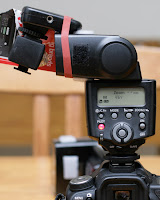
I posted and article called Sync speed and flash duration earlier this year describing a hack to enable cameras with mechanical shutter to shoot using a flash at shutter speeds over the cameras max sync speed WITHOUT using a proprietary flash system. Since then a little more info has become available so I thought I'd write another article focusing on how to do it rather than just investigating what it is. If you want more info on mechanical shutter and why it works then have a reader of the other article here.
So what do you need?
So what do you need?
- Camera
- a proprietary flash that can do HSS/FP
- A flash with manual settings
- An optical slave
- Optional: Radio trigger and a way to attach the optical slave to radio trigger
If you are using a Nikon camera with PC port I believe you can do this without the optical slave and connect either the flash or a radio trigger directly to your cameras PC port.
Ok now to put it together . . .

- Put the proprietary flash on the camera and select HSS/FP mode (this is the trigger so reduce power and point away from subject if you don't want to use as a light source)
- Select full power on the manual flash
- Put the optical slave where the on camera flash will trigger it
 Then the manual flash can be connected by a number of different methods, either directly to the slave, with a PC cord or a radio trigger can fill this gap, i.e. the transmitter can be attached to the optical slave and the receiver to the flash.

And . . . Ta Daaaa, you have a system that should give you HSS using a camera with a mechanical or focal plane shutter. You still need to remember that we are now using the flash as a continuous light source rather than an instantaneous flash, therefore shutter speed will now affect the exposure of the flash. Because the "continuous light source is not on for long and varies in power you will also see some light drop off across the frame, particular as the shutter speed gets higher. This also means that you will not get the large relative "gain" in power you can when you have a camera with an electronic shutter but it is another technique to keep in the back of your mind that might be useful one day.
Thursday, 3 April 2008
Sync speed and flash duration
Many off-camera-flash users got excited when they found out they could use their flashes above the camera's normal sync speed if the camera had an electronic shutter. Well now there is a way to get high sync speed even if the camera has a mechanical shutter!
Now I can't claim credit for this, I read about it in the Strobist forum here and here.
First some background:
When a camera with a mechanical shutter is triggered the bottom of the shutter opens and when the exposure has been long enough the top of the shutter closes (it can also open from the bottom up). Up to a cameras top sync speed there is an instant where the entire shutter is open, when you go faster than this speed the shutter will be closing before it is full open, kind of giving a band of light that crossing the shutter plane.
So what does this mean for a flash? Well because a flash duration for most speed lights is approximately 1/1000 seconds long if it goes off when the shutter plane is only part way open it will look like this.

So how can we light the entire shutter plan with one flash when it is never fully open? Well while a flash is very quick, it still has a duration and through a little work around we can make use of this. Now I'm still not entirely sure how it works and don't have the equipment to do all the testing I want but I have my theories. The catch, you need a flash with High Speed Sync (HSS) to trick the camera into syncronising the flash and shutter as if the flash was operating on high speed sync (many little strobes to light the entire shutter plane).
So how did I make it work:
-Take camera - Canon 30D
-Attach flash - 430EX
-Put flash in HSS mode, manual, 1/64 power (so it doesn't contribute to the light much)
-Put Nikon sb-25 on an optical slave, manual, 1/1 power (longest flash duration)
-Start shooting
Results:

(click for larger image)
Nikon users have been attaching their flash via their camera's PC sync port, I don't have a cable so I can't try that however I did attach an eBay trigger to the PC sync port and it didn't work. I don't know if this is a difference with the port or just that the eBay triggers aren't great. Drop me a comment if you've had success with a canon.
Edit: Canon users can not use the PC sync port for this so they will have to be content using an optical slave (which actually doesn't trigger all that well from a flash in HSS mode).
Now why I think it works:
Well we are using the flash duration so that during the single "flash" the entire shutter plane is opened as some point, the flash suddenly becomes like a continuous light source. Why does it only work when the camera thinks it is doing HSS, well I think in HSS mode the flash triggers a little earlier and this allows it to overlap better with the shutter.
It isn't without its losses and it ain't perfect but I'm sure it'll come in handy at times. Anyway let me know what your experience with it is and if you have any other ideas on why it works.
UPDATE: I've added some further info in a blog post here.
Now I can't claim credit for this, I read about it in the Strobist forum here and here.
First some background:
When a camera with a mechanical shutter is triggered the bottom of the shutter opens and when the exposure has been long enough the top of the shutter closes (it can also open from the bottom up). Up to a cameras top sync speed there is an instant where the entire shutter is open, when you go faster than this speed the shutter will be closing before it is full open, kind of giving a band of light that crossing the shutter plane.
So what does this mean for a flash? Well because a flash duration for most speed lights is approximately 1/1000 seconds long if it goes off when the shutter plane is only part way open it will look like this.

So how can we light the entire shutter plan with one flash when it is never fully open? Well while a flash is very quick, it still has a duration and through a little work around we can make use of this. Now I'm still not entirely sure how it works and don't have the equipment to do all the testing I want but I have my theories. The catch, you need a flash with High Speed Sync (HSS) to trick the camera into syncronising the flash and shutter as if the flash was operating on high speed sync (many little strobes to light the entire shutter plane).
So how did I make it work:
-Take camera - Canon 30D
-Attach flash - 430EX
-Put flash in HSS mode, manual, 1/64 power (so it doesn't contribute to the light much)
-Put Nikon sb-25 on an optical slave, manual, 1/1 power (longest flash duration)
-Start shooting
Results:

(click for larger image)
Nikon users have been attaching their flash via their camera's PC sync port, I don't have a cable so I can't try that however I did attach an eBay trigger to the PC sync port and it didn't work. I don't know if this is a difference with the port or just that the eBay triggers aren't great. Drop me a comment if you've had success with a canon.
Edit: Canon users can not use the PC sync port for this so they will have to be content using an optical slave (which actually doesn't trigger all that well from a flash in HSS mode).
Now why I think it works:
Well we are using the flash duration so that during the single "flash" the entire shutter plane is opened as some point, the flash suddenly becomes like a continuous light source. Why does it only work when the camera thinks it is doing HSS, well I think in HSS mode the flash triggers a little earlier and this allows it to overlap better with the shutter.
It isn't without its losses and it ain't perfect but I'm sure it'll come in handy at times. Anyway let me know what your experience with it is and if you have any other ideas on why it works.
UPDATE: I've added some further info in a blog post here.
Wednesday, 13 February 2008
Do you CLS or ETTL??
I've been following "RadioPopper" development for a few months now and I reckon they look pretty spiffy! They have just release more details and photos of their "P1" (One channel ETTL/CSL) units.
The basic idea is that they take the optical IR signal from an ETTL/CLS master unit and transmits it to the slave flash using a radio signal, thus greatly extending the range and improving line of site issues typical with IR communication.
Unfortunately I don't have much use for the "P1" units as I don't have an ETTL master (and only the one slave) but I am definitely looking forward to the release of the RadioPopper Jnr units. They will be a simple radio trigger using a similar design (without the optical stuff) that will hopefully be more reliable and have greater range than the GI triggers for a similar price.
To stay up to date on the detail have a look at the RadioPopper Blog.
The basic idea is that they take the optical IR signal from an ETTL/CLS master unit and transmits it to the slave flash using a radio signal, thus greatly extending the range and improving line of site issues typical with IR communication.
Unfortunately I don't have much use for the "P1" units as I don't have an ETTL master (and only the one slave) but I am definitely looking forward to the release of the RadioPopper Jnr units. They will be a simple radio trigger using a similar design (without the optical stuff) that will hopefully be more reliable and have greater range than the GI triggers for a similar price.
To stay up to date on the detail have a look at the RadioPopper Blog.
Tuesday, 12 February 2008
Cactus/GI/Ebay triggers - Modifications
I may have mentioned something in my first post about being a little busy, well recently that's a been mild understatement.
One of the first things I wanted to write about is my experience with the "eBay" flash triggers but since I haven't had time to do any writing - let alone proper testing I thought I'd start with a link to Jeremy Kuster's blog that gives a detailed write-up of some modifications you can make to these units.
One of the first things I wanted to write about is my experience with the "eBay" flash triggers but since I haven't had time to do any writing - let alone proper testing I thought I'd start with a link to Jeremy Kuster's blog that gives a detailed write-up of some modifications you can make to these units.
Subscribe to:
Posts (Atom)

 Posts
Posts

